
An application for Bank Statement is one of the most frequently written letters to banks, as individuals and businesses often need an official record of their financial transactions. Whether for visa applications, tax filing, loan applications, or any other purpose of tracking finances and performing a Bank Balance check, the bank statement is a document of great importance. Writing a clear and professional application ensures your request is processed quickly and correctly.
This article has everything you need-from understanding what a bank statement application is to ready-to-use Word and PDF templates you can instantly download. Each section is designed to help you write a flawless and effective letter that looks professional and serves your purpose perfectly. Let’s explore how to write an Application for Bank Statement step-by-step.
What Is an Application For Bank Statement?
The application for a bank statement is a formal written request sent to the bank manager requesting a copy of your account statement for a certain period. This statement provides a detailed list of your financial activities: deposits, withdrawals, transfers, and the running balance. It acts as proof of one’s financial transactions and is often required for official verifications.
This application can be both handwritten or typed; it depends on the requirement of your bank. However, a typed and properly formatted letter looks formal and minimizes chances of misunderstandings and delays. Most banks today also accept requests via email or online forms, but submitting a printed application ensures a stamped, certified copy, which is often required for visa or legal use.
An effective, polite bank statement request letter ensures that the communication with the bank will remain professional, and the financial records will be issued to you without any delay.
Why Do You Need a Bank Statement Application?
Many situations require writing an application to get a bank statement. The following are the most common reasons this type of letter becomes necessary:
1. For Visa or Passport Verification
Many embassies and passport offices ask for bank statements from the last 3 to 6 months. This document shows your financial stability and helps verify your capability to support yourself abroad. A well-written application ensures you receive an official, signed, and stamped copy that is acceptable for embassy submissions.
You can also request that any errors in the statement be corrected so that the official record is reliable to go into your visa file. Without a proper application, you may get an informal or incomplete one that may not meet visa documentation standards.
2. For Loan or Credit Card Application
A bank, NBFC, or an online lender asks for your most recent bank statement as a means of checking your creditworthiness. In cases of loan or credit card applications, this is basically proof of your income, repayment history, and financial discipline. You ensure the statement has all the details necessary by writing a clear request letter mentioning the purpose and duration of the loan officer’s review.
In many cases, financial institutions require only stamped and signed statements. Hence, a written application becomes mandatory for receiving a certified document suitable for official verification.
3. For Income Proof or Employment Verification
Employers or government authorities may ask for a bank statement to confirm your salary credits or monthly income flow. Writing a formal request ensures you receive a verified copy that can be confidently shared with the HR departments or verification agencies. It also helps to avoid data manipulation, since official statements carry the authentication marks of the bank.
Submitting this document alongside a job application or background check will add more credibility to your profile and make it look professionally presented.
4. For tax filing or financial audit
Every financial year, individuals and businesses rely on bank statements to verify income, interest earnings, and transactions. These statements, therefore, make filing of tax return, GST reporting, and audit verifications quite simpler. A well-written application means that you get a complete record without anything missing out on any month or entry.
Having an authentic statement also helps accountants easily identify any discrepancies or unauthorized transactions. A formal letter is your assurance that the document comes from a trusted, official source.
5. For Personal Record or Account Reconciliation
Sometimes, you may want your bank statement for personal tracking or verification of expenses; in such a case, you can note “personal record purpose” in your application. A precise and courteous letter will help the bank understand your request and issue the document without confusion. Most people use the month or quarterly statements to reconcile their income, savings, and digital transactions for purposes of transparency in daily life, leading to financial discipline.
How to Write an Application for Bank Statement
Writing a professional application for a bank statement is quite easy once you follow the right structure. Let’s look at the essential elements your letter should contain:
1. Sender’s Information
Start by placing your name, address, and contact information at the top. This helps the bank staff verify who you are and locates your account easily. The information provided should always match with your bank records, especially the registered address and contact number.
2. Date
Mention the date on which you are writing the application. It helps both you and the bank to keep proper documentation and acts as a future reference for follow-ups.
3. Bank Details
The recipient’s details should include The Branch Manager, the name of the bank, and the branch address. If possible, include the branch code to make it more specific. This ensures that your letter reaches the right authority as fast as possible.
4. Subject Line
The subject should be short yet clear. A subject like “Request for Bank Statement from January 2024 to June 2024” immediately informs the bank about the purpose and time period, thus reducing confusion and speeding up processing.
5. Body of the Letter
In the body of the letter, state your account number, account type-savings or current- and the period for which you need the statement to be issued. You can also mention why you need the document, such as for a visa process, loan, audit, etc. End the paragraph politely with a thank-you note.
6. Signature and Contact Information
Close the letter with “Yours sincerely” or “Yours faithfully.” Under the signature, write your full name and mobile number for easy contact in case the bank needs further information.
Sample Application for Bank Statement (General Use)
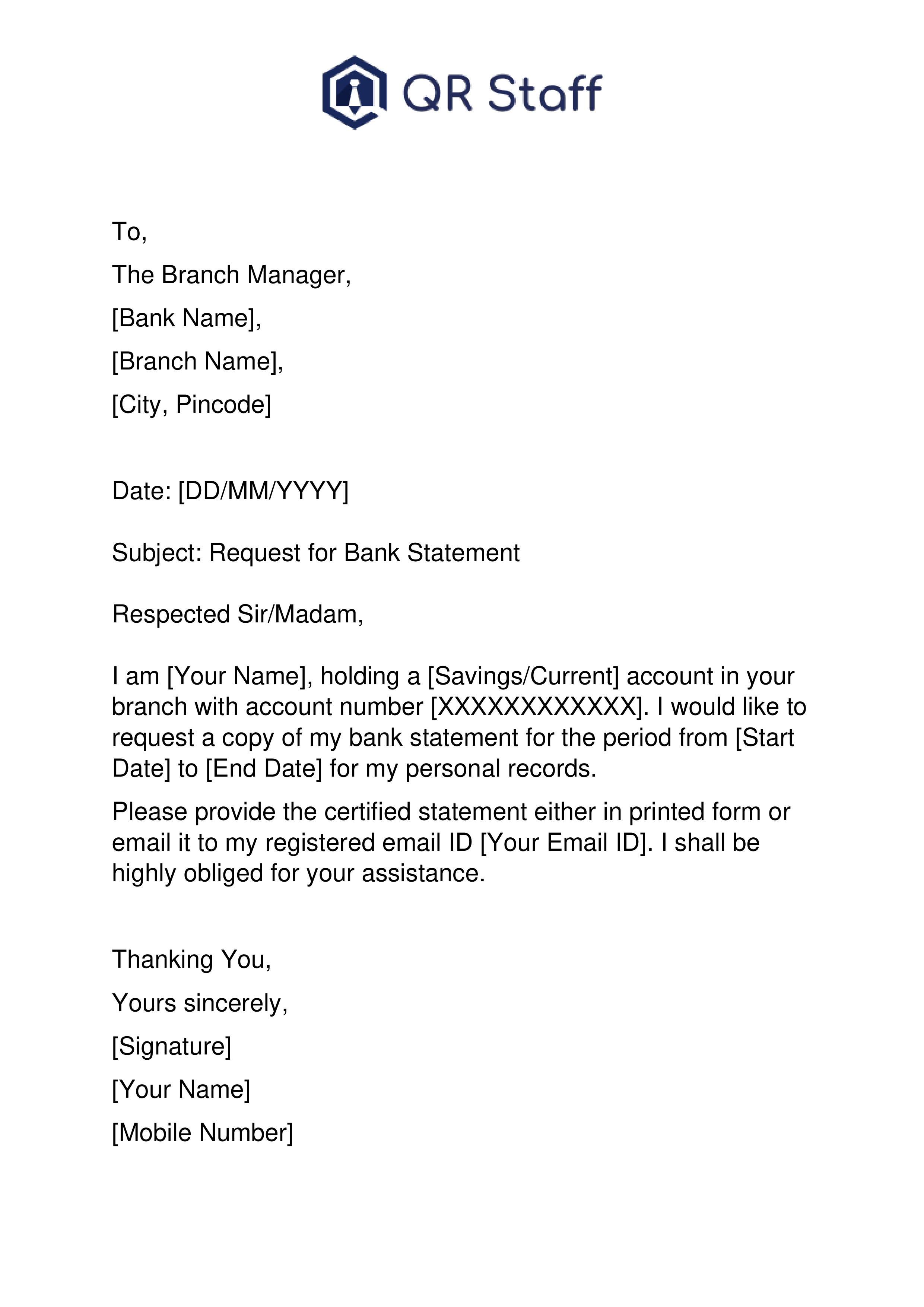
This is a standard, professional format suitable for any general purpose, whether for personal use, documentation, or verification.
Sample Application for Bank Statement (For Students or Visa Purpose)
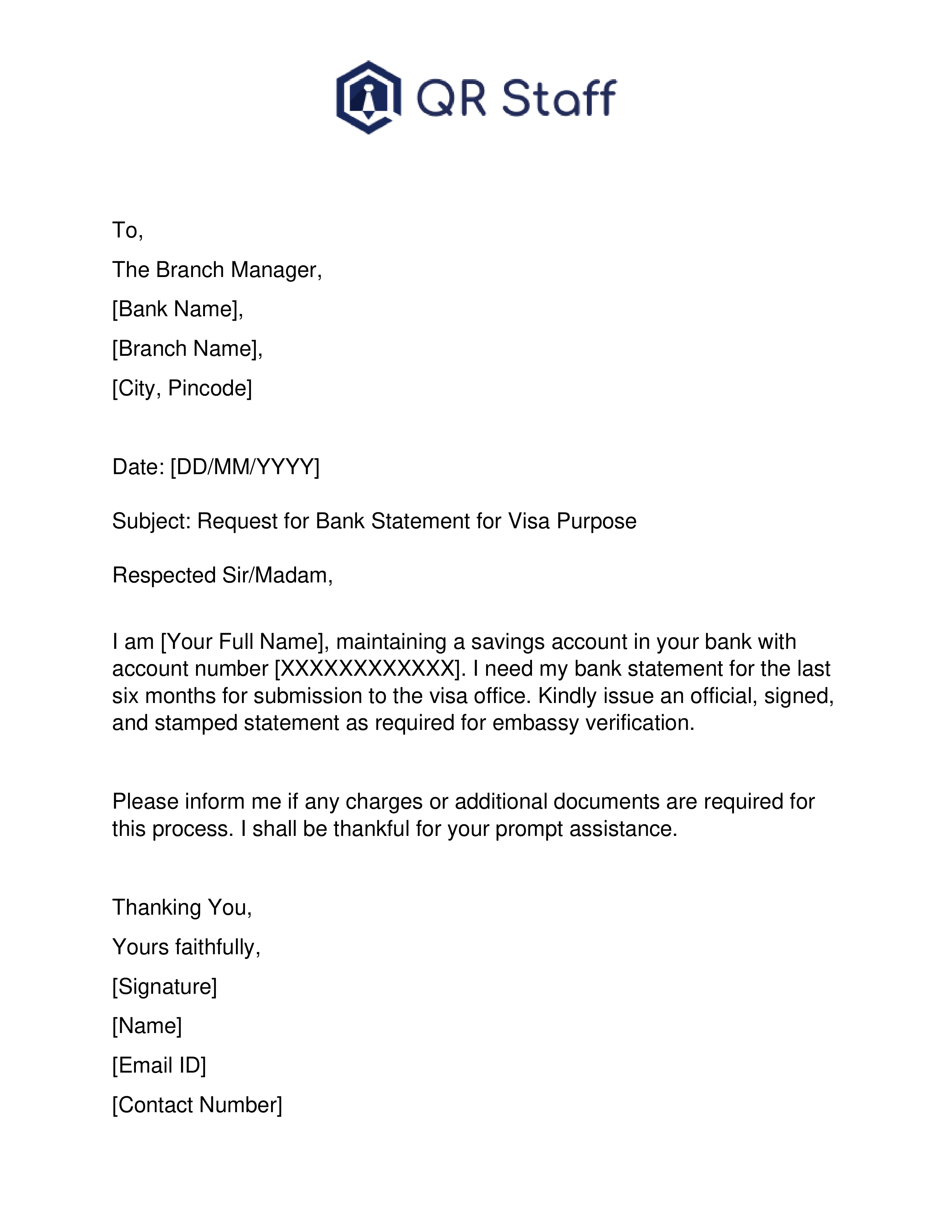
This version is ideal for students applying for educational visas or individuals traveling abroad for professional purposes.
Sample Application for Bank Statement (For Business Accounts)

This format works best for corporate or business purposes where authenticity and audit compliance are important.
Sample Email Format for Bank Statement Request
For online-savvy users, most banks now accept email-based statement requests. Here’s how you can structure your message:
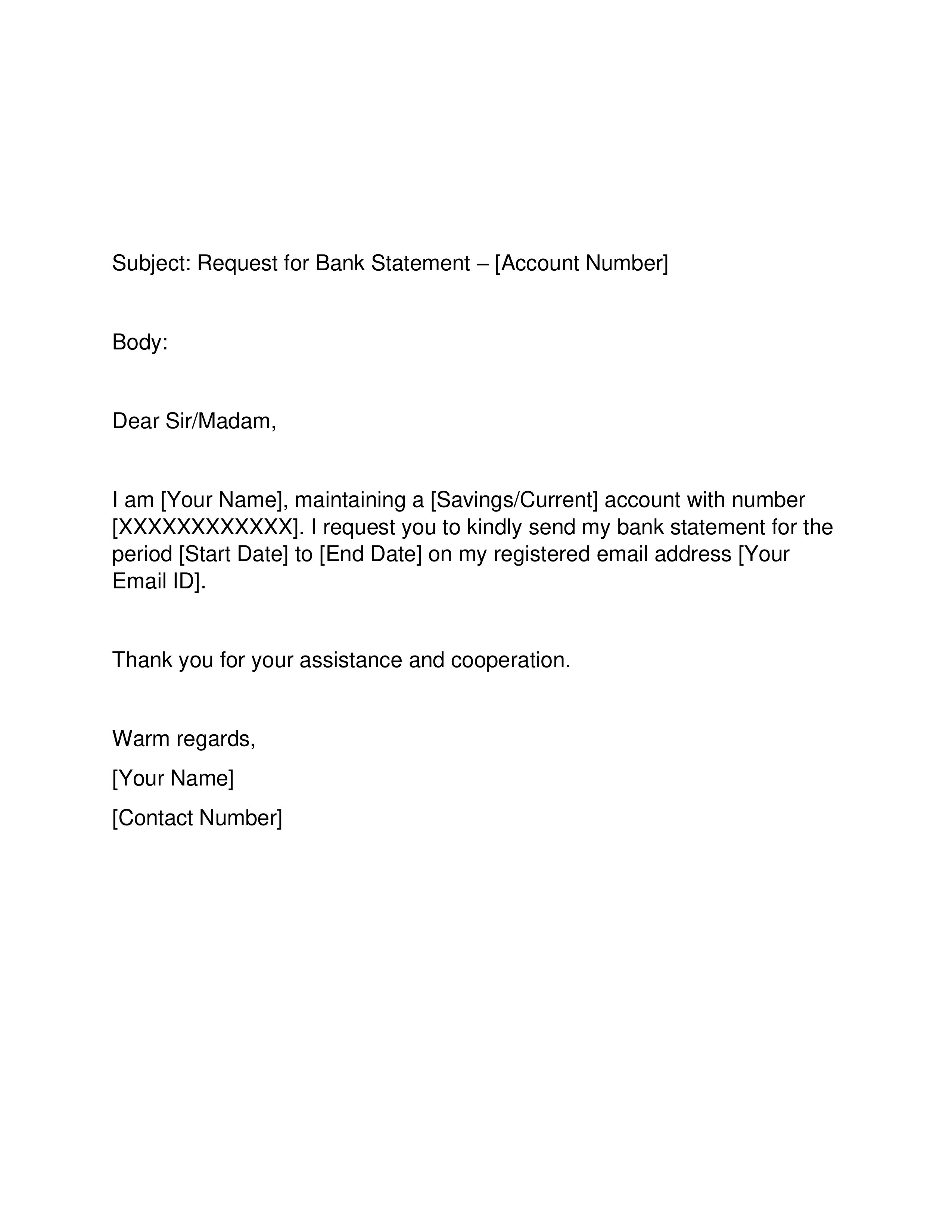
This method is convenient, fast, and paperless, especially for customers who have registered their email IDs with the bank.
Download All-In-One Bank Statement Application Templates (Word & PDF)
To simplify your work, we’ve created free, editable templates in Word (.docx) and PDF (.pdf) formats. These templates are designed with proper formatting and professional tone, ensuring your request looks clean and polished.
[Download Application for Bank Statement – Word Format]
[Download Application for Bank Statement – PDF Format]
You can fill in your name, dates, and purpose directly in the file, print it, or email it as per your convenience.
Expert Tips for Writing a Perfect Bank Statement Application
1. Use a Clear Subject Line or Heading
Always start your application with a straightforward subject line, such as “Application for Bank Statement” or “Request for Bank Account Statement.” This will help the staff in the bank instantly comprehend your purpose. A clear subject line saves time and ensures your request will be forwarded to the right department without confusion.
2. Provide Complete Account Details
Please include your full name, account number, branch name, and contact number. These details help the bank in easily identifying your account and therefore carrying out your request on time with no delays. Try not to provide partial or incorrect information, as that may lead to unnecessary rejections or verification delays.
3. Specify the Required Time Period
Clearly mention, for example, the period of time for which you require the statement: “from January 2024 to June 2024.” This will make your request specific and ensure that the bank doesn’t send incomplete or incorrect data. If you need this in digital form, specify whether you’d prefer email or printed format.
4. Keep the Tone Polite and Professional
Adopt a respectful and formal tone throughout your letter. Phrases like “I kindly request,” “Please provide,” and “I shall be grateful for your assistance” create a courteous impression. Politeness goes a long way in ensuring that your request is handled quickly and positively by the bank officials.
5. Clearly State the Purpose
Most banks require stating the reason why the statement is needed, such as proof of income, visa application, and loan processing. Adding a reason provides clarity and helps them provide the statement in the proper format, whether stamped, signed, or digital. In addition, it ensures that all of the bank’s rules regarding documentation are followed.
6. Attach Supporting Identification Documents
Always attach a copy of your ID proof, such as an Aadhaar card, PAN card, or passport, to confirm your identity. This step is especially important if you are submitting your application offline or on someone else’s behalf. This will help the bank authenticate your request safely and speedily.
7. Mention Your Preferred Delivery Method
State clearly if you want the statement via email, by post, or in person. This keeps the bank out of the guessing game and thus avoids delays. In case of digital statements, make sure your registered email ID is updated with the bank for secure receipt of documents.
8. Add Thank You Note at the Bottom
Close your application with one or two lines of gratitude, like “Thank you for your time and assistance.” A positive closing note not only shows respect but also leaves a professional impression. Small acts of politeness will help build a good rapport with the bank staff.
9. Double-Check for Spelling and Format
Before submitting your application, ensure grammar, spelling, and formatting errors have been eliminated. Use clean layout, short paragraphs, and proper spacing. A neat and error-free application is professional; it will convey your message appropriate and clear.
Common Mistakes to Avoid When Writing a Bank Statement Application,
1. Not Mentioning the Account Details Properly
The biggest mistakes people make include not mentioning their account number, full name, and branch details. If this is not there, the bank will not be able to identify your account, and it might get delayed or rejected. Always double-check these details before submitting your request.
2. Forgetting to Specify the Statement Period
Many applicants simply write “I need my bank statement” without mentioning the date range. It creates confusion for the bank staff, as they will not know if you need one month, six months, or a full year’s record. You should clearly mention the period, like “from January 2024 to June 2024” to ensure proper processing.
3. Writing in an Informal or Casual Tone
A common mistake people make is to write the entire application in an informal or casual tone. Statements like “Hey, please send my statement” or even “I want my bank record ASAP” sound unprofessional. Always adopt a polite, respectful, and formal approach since it speaks volumes about seriousness and professionalism.
4. Missing the Purpose of the Request
Banks often ask for the purpose for which the request is being made, like applying for a loan, income proof, or verification for a visa. Omitting this may lead to unnecessary delays as the bank might get in touch for clarification. A clear purpose ensures that the bank issues the statement in the proper format.
5. Not Attaching Identification Proof
Not including a valid ID proof while submitting your request offline or via email is one of the major mistakes. Banks might deny your application owing to security reasons as this verification is required. Attach a photocopy of your Aadhaar, PAN, or any government-issued ID card and confirm your identity.
6. Writing an incomplete or confusing application
Some applicants write very short applications or unclear ones, lacking in necessary details. This will force the bank to get back to them for clarification. Always make sure your application includes all details — account information, duration, purpose, and preferred delivery mode — in a simple, structured way.
7. Forgetting to Mention Contact Details
If you do not provide your contact number or registered e-mail ID, the bank cannot intimate you when the statement gets ready or in case they require additional information. Always provide an active contact number or email so that the communication process is smooth and quick.
8. Not reviewing before submission
Small spelling mistakes, formatting issues, or lack of details can reduce the legibility of your letter. Review your application carefully before sending it to the bank. A quick proofreading step helps you maintain professionalism and avoid unnecessary confusion.
9. Not keeping a copy of the application
Some people fail to keep a copy of their request for personal records. If there is an issue afterward, you will not have proof of your submission. Always keep a copy, in electronic or printed form, of your application for future reference and tracking.
Benefits of Writing a Well-Structured Bank Statement Request
1. Assures Speedy Processing
A well-structured request for a bank statement makes the personnel in the bank clearly understand your requirement-whether date-wise, purpose, or account. The bank can process all such requests quickly if all the details are correctly mentioned, such as account number, period, and even contact information, without seeking further clarifications.
2. Reduces Chances of Rejection
Applications that are incomplete or not clear could be denied or disregarded by the banks. A well-written application eliminates confusion because it will contain all the information required, and the tone will be courteous. This will ensure that your application meets the bank’s requirements once, thus saving a lot of your time.
3. Maintains Professionalism
A formal letter of request signifies professionalism and a keen sense of detail. Whether you are a student, employee, or business person, an effective application gives a good impression and reflects your seriousness in maintaining proper financial records.
4. Helps in Maintaining Personal Financial Records
You can easily keep a record of your financial correspondence by submitting a properly formatted request for a statement of account. This helps you stay organized and makes it easier to track when and why you requested a statement — helpful for tax filing, audits, or even visa applications.
5. Strengthens Communication with the Bank
A properly structured letter builds clear communication between you and your bank. It will be quite easy for a bank representative to identify your needs and communicate accordingly. Good communication ensures transparency, instills trust, and ultimately has smoother implications on future financial deals.
6. Supports Legal and Official Requirements
Many times, a bank statement is needed for official purposes like loan applications, visa processing, or even income verification. A well-written request ensures that the bank issues a correct and properly dated statement that can be confidently used for such legal or official needs.
7. Saves time for both you and the bank
Since all the necessary information is provided in the statement, the bank does not have to get in touch for further details. This eliminates a lot of time-consuming processes and allows you to get your statement as soon as possible without much hassle on either end.
Conclusion
Writing an application for a bank statement might seem like a minor task, but getting it right can save you a lot of time, ensure everything is accurate, and make the whole process a breeze. Whether you need it for visa applications, tax filings, or a business audit, a well-crafted application showcases your professionalism and financial responsibility.
If you’re juggling multiple employees or managing payroll, keeping accurate financial records becomes even more essential. That’s where QR Staff comes in—a top-notch app for staff attendance and payroll management that makes your job so much easier. It helps you keep track of employee attendance, payroll, and financial records in an organized way, guaranteeing accuracy in every transaction.
Give QR Staff a try today and discover a modern, hassle-free approach to managing attendance and payroll!
FAQs on Bank Statement Application
1. How to apply for a bank statement online?
You can apply for a bank statement very easily through the official website of your bank or its mobile app. After logging in, go to the “Account Statement” or “e-Statement” section. Select your account, choose the date range you want-let’s say the last 3 or 6 months-and click on “Download” or “Request Statement.” Many banks also provide the option to receive statements directly via email in PDF format.
2. Do banks charge for bank statements?
Almost all banks issue monthly e-statements free of cost via online banking or, at least, email. In case you require a printed copy or a duplicate statement from the branch, you may be asked for payment of the nominal fee that is applicable for the number of pages or months you request. The charge will depend upon the bank’s policy. It’s always best to check your bank’s service charge list before applying.
3. How much amount of fee shall be charged to issue a statement of account in bank?
The charges for the issuance of Bank Statements are different from bank to bank and depend on the mode of delivery. Usually, banks can charge anything between ₹50 to ₹200 per statement when you request a physical copy from the branch. Digital statements accessed online or via email are usually free of cost. Some banks also offer a few free printed statements per year before applying the standard charges.
4. How many months of statements can I request online?
Most banks provide access to 6 months of statements, which can be downloaded or viewed online. However, there are some banks from which as many as 12, or even 24 months of e-statements can be accessed through internet banking. You can request older statements by submitting a special request at your branch, where additional charges may apply depending on the period requested.
5. Can I apply for a bank statement online?
Yes, you can apply for a bank statement online through your bank’s digital services. Just log in to your net banking or mobile app, click “Account Statement,” and select the period you want. You can either view it instantly, save it in PDF or Excel format, or request it be sent on your registered email ID. This process is fast, paperless, and hassle-free.
- How to apply for bank statement online
- Do banks charge for bank statements?
- How much amount of fee shall be charged to issue of statement of account in bank
- How many months of statements can i request online
- Can i apply for a bank statement online
Leave a Reply