
The telecaller job description forms an important part of any communication and sales activity in contemporary business. Be it a startup, small office, call center, banking company, or service-based, tele callers are at the frontline every day to connect brands with customers. Their tasks extend beyond making phone calls: they answer customer questions, gather information, create leads, resolve problems, follow up on potential buyers, and support the communication flow of the organization as a whole. With the growing digital functions of businesses today, more and more businesses feel the need to have tele callers because they provide a cost-effective way to enhance customer interaction, sales conversion, and customer support.
In today’s fast-moving market, every business relies on direct communication for building trust; a telecaller job makes sure this communication goes smoothly. They are the voice of the company, representing the values of the brand and offering a positive customer experience. Whether this is an inbound or outbound job role, tele callers are expected to handle bulk calls, maintain proper call records, and offer quality services. This blog will give you a complete understanding of the job description, responsibilities, required skills, and hiring tips related to a tele caller, thus making it a perfect guide for businesses and HR professionals.
What is a telecaller?

A telemarketer is a professional who manages calls, either inbound or outbound, to communicate with customers, clients, or leads. The main objective is to provide information, introduce products or services, answer questions, and build relationships through effective communication. Tele callers are found in various sectors, including insurance, real estate, education, healthcare, banking, retail, and call center’s. They must be confident speakers who can maintain a polite conversation even under pressure.
Unlike field sales executives who interact physically with customers, Tele callers do their jobs through phone calls or, at times, online communication tools such as WhatsApp and email. This makes the job much more flexible and cost-effective for businesses. Tele callers also generate leads by identifying potential customers and follow up until the sales team takes over. Their ability to influence customers with voice and tone makes them an important asset to any sales-driven team.
Telecaller Job Description (Explained)
A tele caller job is to connect with prospective or current customers to explain products or services, resolve concerns, and encourage positive outcomes. This also involves call record keeping, database updating, reporting of daily activities, and performance targets met. Often, as a tele caller, one is designed to follow certain scripts and company communications policies while being natural with their speech. They should also be good listeners who understand customer requirements and respond accordingly.
The other responsibilities of a telecaller include coordination with internal teams for sales, marketing, and support for smooth operations. They may also be tasked with the transfer of high-quality leads to senior executives. The telecaller job requires much patience, attention to detail, and strong communication skills. Based on the different companies, the role of a tele caller can be further categorized as inbound calling, outbound calling, sales calling, support calling, verification calls, or follow-up calls.
Types of Telecaller Jobs Roles
1. Inbound Telecaller
Inbound telecallers job vacancies are those who receive calls from customers. They address queries on customer service, complaints, and product information. Their line of work demands quick responses, problem-solving skills, and the ability to keep their tone composed during tense situations. Inbound tele callers also log customer complaints or queries into the system for future follow-up. This is considered a very important role in customer support settings.
2. Outbound Telecaller
An outbound telecaller job makes calls for sales, marketing campaigns, lead generation, feedback collection, or reminders to customers. They usually have a script they work with, but they should be able to adjust the conversation based on customer interaction. Outbound calling will require convincing communication, target orientation, and handling rejection professionally. It is a major contributor to business development.
3. Sales Telecaller
This role emphasizes the conversion of leads to customers. Sales telecallers explain the product benefits, negotiate the price, and convince the customer to make the purchase. Regular follow-up, sharing offers, handling objections, and closing the deal over the phone are their usual tasks. Strong selling skills with a result-oriented approach are needed for this position.
4. Customer Support Telecaller
Supporting telecaller job helps customers with service-related issues. They help to troubleshoot the problems, guide them step by step, raise support tickets, and ensure customer satisfaction. Here, the focus is more on solving the concern rather than selling. Patience, empathy, and understanding are the key strengths required.
5. Collection or Recovery Telecaller
The telecaller reminds the customer about pending payments, EMI dues, or subscription renewals. They will have to communicate politely while recovering their dues on time. The requirements are good negotiation, firmness, and accuracy in maintaining records.
Telecalling Job Responsibilities You Should Know About
1. Making and Receiving Calls
The role mainly includes making outgoing calls or attending incoming calls, whichever the designation demands. Telecallers are supposed to be professional, friendly, and confident during the call. They should manage the call flow effectively for quicker resolutions and upkeep of high call productivity. Balancing speed with quality is very much crucial for meeting daily targets.
2. Product and Service Explanation
The telecallers should clearly and concisely explain the products or services of the company. They should do this according to the customer’s level of understanding without using any technical terms that they cannot fathom. Effective telecallers adjust their communication to suit customer needs for the building of trust. They should also speak to the benefits and handle customer objections.
3. Lead Generation and Follow-up
A big portion of the work related to telecalling involves identifying prospective customers and adding them to the lead database. They follow up on leads that show interest, share relevant product details, and help leads take further action. Effective follow-up calls will enhance the possibility of conversion of warm leads into sales. They maintain follow-up schedules and call reminders.
4. Maintaining Call Records and Data Entry
They need to update customer information, call notes, feedback, and follow-up in CRM or Excel sheets. Data entry accuracy will make the collaboration with sales executives easier and smoother. The call logs also help them track their performance and understand customer behavior. Good record-keeping minimizes confusion and helps save time from wasted efforts.
5. Meeting Daily and Monthly Targets
Each telecalling role has specific targets assigned to it, like the number of calls, leads generated, conversions, or even customer satisfaction ratings. Telecallers need to be consistent and motivated enough to achieve these targets. Meeting targets demands discipline, planning, and proper time management. Target-oriented performance aids smooth operation management of companies.
6. Building Customer Relationships
Since a telecaller is the point of contact, establishing a good relationship is paramount. They have to listen attentively, be empathetic, and respond in a friendly way. Customer relationship building assists in retaining clients and makes them feel important. A telecaller’s behavior directly influences the company’s reputation, since it builds customer trust.
Essential Skills Required for Telecallers Job
1. Strong Communication Skills
The most important skill for a telecaller is verbal communication. They should speak clear, confident, and polite, but in a natural conversational tone. Good communication helps them explain information more clearly and build rapport with customers. Listening skills are equally important for understanding the needs of the customer. A good telecaller modifies one’s tone according to the situation.
2. Persuasion and Selling Skills
In sales-related jobs, the art of convincing customers is an important element. Telecallers need to emphasize benefits, overcome objections, and influence customer decisions without sounding pushy. Persuasion involves a good dose of confidence, product knowledge, and emotional intelligence. Good salespeople know when to speak and when to stop talking. They would study customer response patterns and adjust their behavior appropriately.
3. Patience and Emotional Control
Tele-callers have to cope with customers who are polite, impatient, or rude. It is significant to stay calm, patient, and professional. Being in emotional control ensures that the tone of the conversation remains respectful and productive. Telecallers should never show negativity but resolve issues. This builds up trust and eliminates conflict.
4. Computer & Typing Skills
The use of CRM software, spreadsheets, email tools, and calling systems is a must for telecallers. Basic knowledge of computers and a high typing speed will enable them to update information within the software on their computers while talking with the customers. Good digital skills reduce errors and improve efficiency in work. Telecallers should also understand how to navigate through software during the calls quickly. This ensures smooth workflow.
5. Problem-Solving Ability
They handle customer complaints or product-related issues. The telecaller needs to quickly analyze the problem, find solutions, and keep the customer updated about their issue. Problem-solving abilities ensure customer satisfaction and minimize escalations. It is also important to know when to escalate complex cases to senior team members. That’s the balance that ensures professional handling of all situations.
6. Time Management Skills
Telecalling involves a lot of calls and follow-up schedules. It requires the telecallers to manage their time wisely to achieve the daily targets. Good planning helps them organize leads, set reminders, and avoid delays. Time management also brings about consistency in performance. The telecallers who have this skill complete their work without any stress.
Interview Questions For Telecaller Jobs Vacancy
There are a few important interview questions that one must know when applying for a telecalling job. These are essential for both employers and applicants.
1. Tell me about yourself.
Interviewers use this to understand your personality, background, and style of communication. It gives them a view of how confidently you put forth basic information about your education, skills, and experiences. This will also help them to decide if your profile fits the role of the job. A clear, structured introduction always helps to make a good first impression.
2. Why do you want to work as a telecaller?
The companies want to know the motivation behind choosing this role. They check whether you enjoy interacting with people, solving queries, and working on a target-based setup. Your answer should reflect interest in communication and customer service. This assures the employer that you will be committed to the job.
3. What do you know about our company?
This question tests whether you researched the organization prior to the interview. Studying the company beforehand is a sign of seriousness and professionalism. The interviewers expect basic knowledge about the firm’s products, services, or market reputation. It proves that you’re genuinely interested in the job.
4. Do you have any experience in telecalling or customer service?
They ask this question to assess your relevant background and skills. If you have experience, you should describe very clearly your responsibilities and achievements. If you are a fresher, you would highlight communication skills, confidence, and a willingness to learn. They want to see how quickly you can adjust to the telecalling environment.
5. How would you handle a difficult or rude customer?
Telecalling automatically involves dealing with difficult customers, and it is natural for employers to gauge your attitude in such conditions. You should explain in your response how you listen attentively, understand their problem, and respond politely. This proves your ability to maintain customer satisfaction even during challenging situations.
6. How do you convince customers over the phone?
The convincing skills are essential for sales and support tele-calling. An interviewer will especially review your approach to engaging customers and building rapport. Techniques include elucidating customer needs, clear explanation of benefits, and keeping the tone friendly. It proves the persuasive communicational power of a candidate.
7. What will you do if the customer declines your offer?
Rejections do occur in telecalling, and that’s why companies would like to know how you handle the situation. Your answer should reflect patience, politeness, and a willingness to follow up later. Explain how you try to understand the concern of the customer and offer alternative solutions. This helps employers to see your resilience and positive attitude.
8. Are you comfortable working with targets?
Telecalling jobs often include targets that are required to be completed daily, weekly, or monthly. Employers ask this to check whether you are motivated by goals. You should highlight the ability to remain disciplined, handle pressure, and manage time effectively. This will show that you can consistently perform in a target-driven role.
9. How good are your communication skills?
This question thus carries some weight since this is a communication-based job. The interviewers notice how clearly you speak, how well you explain things, and how confident you sound. Talk about your listening skills, clarity of speech, and ability to adjust the communication style. This helps them judge your real-time communication ability.
10. Do you feel comfortable with outbound calling?
Outbound calling requires confidence, as you are calling customers that are not necessarily anticipating your call. This is a question asked by employers to see if you can manage objections and rejections. In your answer, show your readiness to approach new leads and initiate a conversation. This will help them confirm your suitability for sales-oriented telecalling roles.
11. How do you stay positive during repetitive tasks?
Telecalling usually includes repeating the same pitch or answering similar questions. Companies would like to know if you will be able to be enthusiastic throughout the day. You are supposed to mention techniques like setting small goals, taking short breaks, and staying motivated. That proves your ability for consistent performance.
12. How do you record customer information after a call?
The telecallers need to make sure that customer records are updated with care and accuracy. Employers ask this to check your attention to detail and familiarity with CRM tools. You should explain how you note feedback, update status, and keep data clean. This will reassure them that you will keep the database organized.
13. What is your typing speed, and computer knowledge?
In most scenarios, telecallers juggle several tasks simultaneously: typing notes while speaking, checking customers’ history, or updating some information. Interviewers ask about typing speed and computer basics to make sure that you can do those things efficiently. You must mention your comfort with MS Office, CRM, and basic software tools. Accurate typing and computer skills enhance productivity.
14. Are you open to shifts or flexible working hours?
Many call centers work both day and night, so flexibility is key. Employers ask this to understand your availability and commitment. Your answer should, therefore, highlight whether you are able or willing to manage regular, rotational, or extended shifts. This will help them schedule you according to business needs. 15. Do you have any questions for us? This question checks your interest and engagement in the interview process. Now’s your time to ask questions about expectations from the job, training, salary structure, or growth opportunities. Asking intelligent questions shows professionalism and seriousness of approach. You also get to know whether this company is a good fit for you.
Why Is A Telecaller Job In Demand?
Telecalling can be a fantastic career choice, offering a wealth of positive opportunities. First off, you’ll pick up a range of skills that can really help you in your professional life. You also have the flexibility to influence your paycheck. In telecalling positions, it’s not uncommon to see your base salary double or even triple thanks to performance bonuses.
Additionally, telecalling is a great way to hone your communication skills. Constantly interacting with new people helps you develop your negotiation and persuasion techniques.
Lastly, you’ll have the chance to gain a lot from various training sessions. In this field, you’ll learn about different products and how to effectively engage with various types of customers.
1. Businesses Need Constant Customer Communication
Every other business needs a person to relate to the customers on a daily basis. Be it sales, support, feedback, follow-ups, or anything else, telecallers play a major role in maintaining communication. With growing competition, no enterprise can afford losing customer engagement. This need, being continuous and regular, makes telecalling one of the high-demand jobs.
2. Growth of Online Businesses and Startups
Not only with the growth of e-commerce, but due to digital services also, more and more companies use telecallers in order to manage the leads and inquiries of customers. Basically, the startups need a telecalling team in order to reach their new customers in less time. Their growth is heavily dependent on regular follow-ups and sales calls. This increases the demand for skilled professionals in telecalling.
3. Telecalling Helps Increase Sales and Revenue
Telecallers directly help in converting leads into sales and generating revenue. Any role that helps companies close a deal faster is coveted. A good tele-calling team would mean high revenue intake and better retention of customers. This therefore makes telecalling a very pivotal job when it comes to the growth of the business.
4. No High Degree Required – Easy to Start Career
One of the biggest reasons for high demand is that telecalling jobs do not require advanced degrees. Good communication skills and basic computer knowledge are enough to get started with this job, making it quite accessible for freshers, students, and those looking for quick employment. More companies hire telecallers regularly for the same reason.
5. Businesses require quick solutions for customer support.
Customers these days expect quick replies for queries and problems. Telecallers facilitate organizations in offering real-time support without any lag. Their ability to solve problems instantaneously enhances customer satisfaction. As customer support is a necessity for every business, jobs related to telecalling are always in demand.
6. Importance of Telecalling in Lead Management
Most businesses depend on leads to expand, and telecallers help in revealing interested customers, collecting data, and setting meetings with the sales force. This smooth process of lead management increases the success rate of the company. Because of this, telecallers are always in demand in marketing and sales forces.
7. High Demand across Various Industries
Banking, insurance, healthcare, education, real estate, and e-commerce, among others, all need telecallers. Since their role is universal, the demand is always stable. As long as businesses exist, the need for telecallers won’t come down. This multi-industry requirement is what makes it a secure job.
8. Cost-Effective for Companies
Hiring telecallers is much cheaper compared to large sales teams. One telecaller can manage multiple tasks: support, marketing, and lead generation-all in one. This makes it cost-effective for companies and increases efficiency. Since this is cost-effective, companies prefer to hire large numbers of telecallers.
9. More opportunities for remote and hybrid work exist.
With the rise of the work-from-home culture, many companies now hire telecallers to work from home. This flexibility attracts more candidates towards the business, and the business can expand easily. Remote telecalling reduces office costs and is more productive. Due to this, the demand for telecalling jobs has increased even more.
10. Opportunities for Easy Skill Development and Growth
Telecalling helps to develop aspects such as communication, confidence, sales skills, and problem-solving. These skills offer more prospects concerning a career in sales, marketing, customer service, and management. People join the ranks of telecalling because it leads to career growth. This, in turn, fuels demand.
Difference Between A Telecaller and Customer Support Executive
The main function of a telecaller is to focus on either outbound or inbound communication for sales, marketing, or lead generation. The aim should be to educate, convince, and capture data, maintaining a positive contact at all times. A customer support executive, however, attends to complaints, troubleshooting, and service requests at post-purchase. Telecallers are sales-driven, while support executives are service-driven. While communication skill sets are needed for both sectors, support roles require much more patience and problem-solving. Understanding the difference helps businesses hire the right talent.
Why Telecallers Jobs Are Important for Business Growth
Telecallers’ job connect businesses with customers directly at very low costs compared to other forms of marketing. They facilitate quick customer feedback, lead generation, and improvement in brand communication. Telecallers help build trust through answering various questions and extending personalized support. Follow-ups carried out by them increase conversion rates, whereas support calls enhance customer satisfaction. In most industries, telecallers act as the backbone for sales and customer support operations. Their contribution puts a big impetus on revenue and customer loyalty.
Telecaller Job Salary Range in India
Their salaries differ based on the location, experience, and industry. Generally, beginners get an average of ₹ 10,000-₹ 15,000 per month in most cities. The experienced ones earn around ₹ 18,000 to ₹ 28,000 per month, especially those who are good at sales. Their net wages increase because of incentives, commissions, and performance bonuses. Telecallers dealing with finance, insurance, and real estates normally gain high incentives. Overall, there is steady growth in the tele-calling profession and opportunities for learning.
Explained Telecaller Job Description
A telecaller job is to connect with prospective or current customers to explain products or services, resolve concerns, and encourage positive outcomes. This also involves call record keeping, database updating, reporting of daily activities, and performance targets met. Often, as a telecaller, one is designed to follow certain scripts and company communications policies while being natural with their speech. They should also be good listeners who understand customer requirements and respond accordingly.
The other responsibilities of a telecaller job include coordination with internal teams for sales, marketing, and support for smooth operations. They may also be tasked with the transfer of high-quality leads to senior executives. The job requires much patience, attention to detail, and strong communication skills. Based on the different companies, the role of a tele caller can be further categorized as inbound calling, outbound calling, sales calling, support calling, verification calls, or follow-up calls.
Types of Telecaller Job Roles
1. Inbound Telecaller
Inbound telecaller job vacancies are those who receive calls from customers. They address queries on customer service, complaints, and product information. Their line of work demands quick responses, problem-solving skills, and the ability to keep their tone composed during tense situations. Inbound tele callers also log customer complaints or queries into the system for future follow-up. This is considered a very important role in customer support settings.
2. Outbound Telecaller
Outbound tele callers make calls for sales, marketing campaigns, lead generation, feedback collection, or reminders to customers. They usually have a script they work with, but they should be able to adjust the conversation based on customer interaction. Outbound calling will require convincing communication, target orientation, and handling rejection professionally. It is a major contributor to business development.
3. Sales Telecaller
This role emphasizes the conversion of leads to customers. Sales telecallers explain the product benefits, negotiate the price, and convince the customer to make the purchase. Regular follow-up, sharing offers, handling objections, and closing the deal over the phone are their usual tasks. Strong selling skills with a result-oriented approach are needed for this position.
4. Customer Support Telecaller
Support tele callers help customers with service-related issues. They help to troubleshoot the problems, guide them step by step, raise support tickets, and ensure customer satisfaction. Here, the focus is more on solving the concern rather than selling. Patience, empathy, and understanding are the key strengths required.
5. Collection or Recovery Telecaller
The telecaller reminds the customer about pending payments, EMI dues, or subscription renewals. They will have to communicate politely while recovering their dues on time. The requirements are good negotiation, firmness, and accuracy in maintaining records.
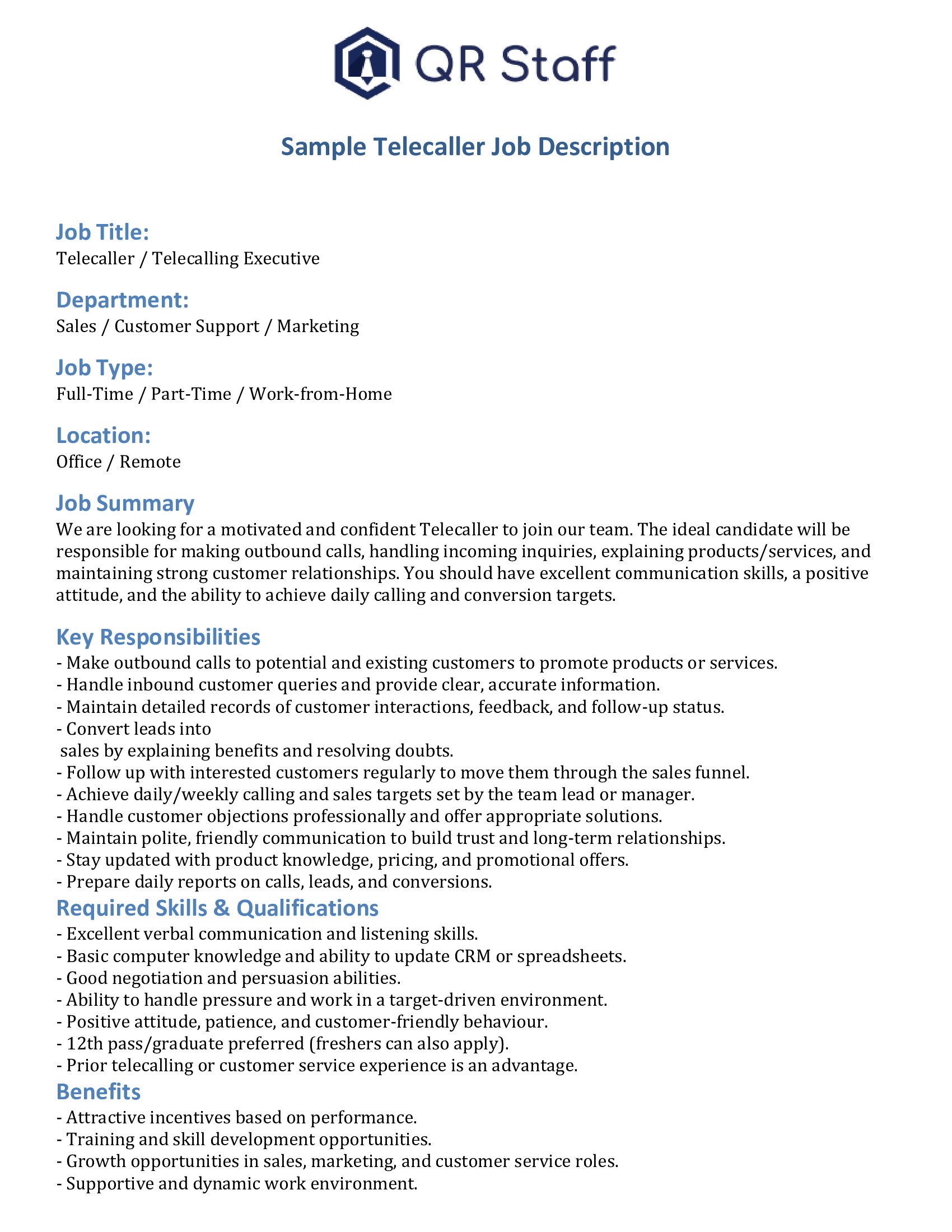
Sample Telecaller Job Description
Conclusion
Telecaller job vacancy are key players in maintaining smooth communication, generating leads, and keeping customers happy. Their job encompasses a wide range of tasks, including making calls, entering data, closing sales, and resolving issues. Hiring skilled telecallers can really enhance business growth, particularly for companies that thrive on direct communication. To better manage telecalling teams, businesses can utilize QR Staff, an innovative attendance and payroll management system. With its QR-based attendance, shift scheduling, salary calculations, and performance tracking, QR Staff simplifies the process of managing a telecaller workforce.
Frequently Asked Questions (FAQs)
The telecaller makes outbound calls and receives inbound inquiries from customers. The main tasks include explaining the products or services, answering questions, generating leads, and converting interested customers into sales. They maintain the records of calls, follow up with potential clients, handle objections politely, and build good relationships with customers.
To prepare for a telecalling job, improve communication skills, specifically clarity and confidence in speaking. Practice listening skills, develop basic product knowledge, and learn handling customer queries professionally. You can practice common tele-calling scripts, work on voice tone, and be comfortable with basic computer tools such as CRM or Excel.
Telecalling is indeed a good job, particularly for those who are beginners or fresh into sales or customer service. The pay is decent enough, the incentives, too, and growth prospects could be achieved pretty fast. You also develop useful skills in communication, negotiation, and customer handling, which could be helpful in other fields as well.
Average compensation for a telecaller varies as per experience, location, and industry. A fresher is normally paid on a basic pay plus performance-based incentives. Most companies have steady growth with bonuses and rewards based on month-on-month or week-on-week targets.
In India, the salary range for a telecaller generally varies between ₹10,000 to ₹20,000 per month for freshers. For experienced telecallers or those in sales-driven verticals, it can be ₹20,000 to ₹35,000+, plus incentives. In high-performance roles, incentives at times can surpass the basic salary amount.