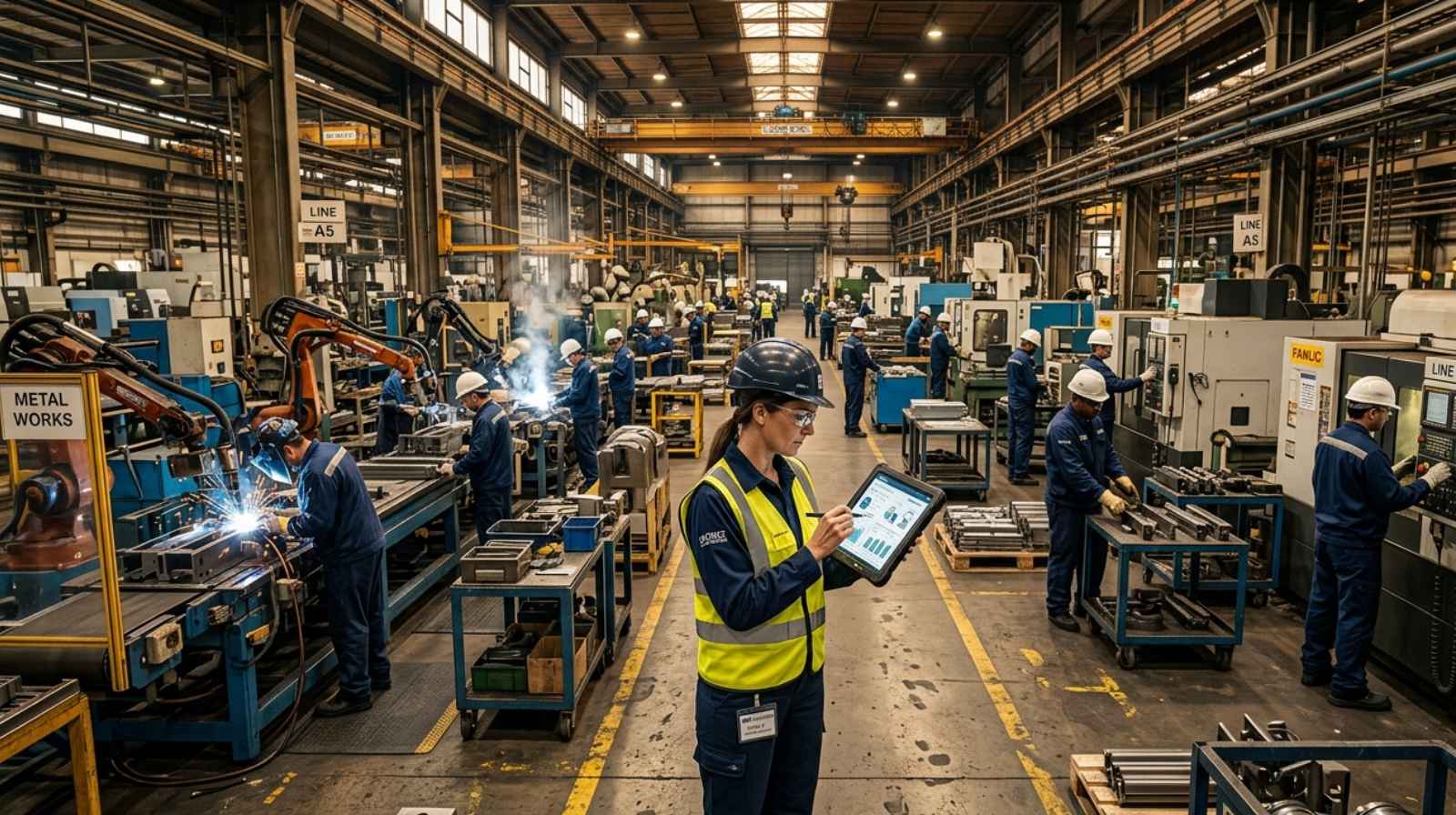
Staff Management Challenges in Manufacturing Units are one of the biggest operational roadblocks for factories aiming to scale efficiently. From attendance discrepancies to shift confusion and compliance risks, these issues directly impact productivity, cost control, and workforce morale.
In a typical manufacturing setup, where hundreds of workers operate across shifts and locations, even small inefficiencies can multiply quickly. Therefore, solving these challenges is not just about HR—it’s about business continuity and profitability.
Let’s break down the real problems and, more importantly, the practical solutions that actually work on the ground.
What Are Staff Management Challenges in Manufacturing Units?
Staff Management Challenges in Manufacturing Units refer to the difficulties in managing large, shift-based, and often distributed workforces. These include tracking attendance, managing shifts, ensuring compliance, and maintaining productivity.
Unlike corporate offices, factories operate in dynamic environments. Workers may rotate shifts, move between departments, or work across multiple sites. As a result, traditional HR systems often fail to provide real-time control and visibility.
Moreover, manual processes still dominate many factories, leading to errors, inefficiencies, and a lack of accountability.
Top Staff Management Challenges in Manufacturing Units
Attendance and Time Tracking Challenges in Manufacturing Units
One of the most common challenges in manufacturing workforce management is inaccurate attendance tracking. Manual registers or biometric systems often fail due to proxy attendance (buddy punching), device failures, or lack of accessibility across sites.
As a result, HR teams struggle with unreliable data, which directly affects payroll accuracy and compliance.
Shift Management Complexity
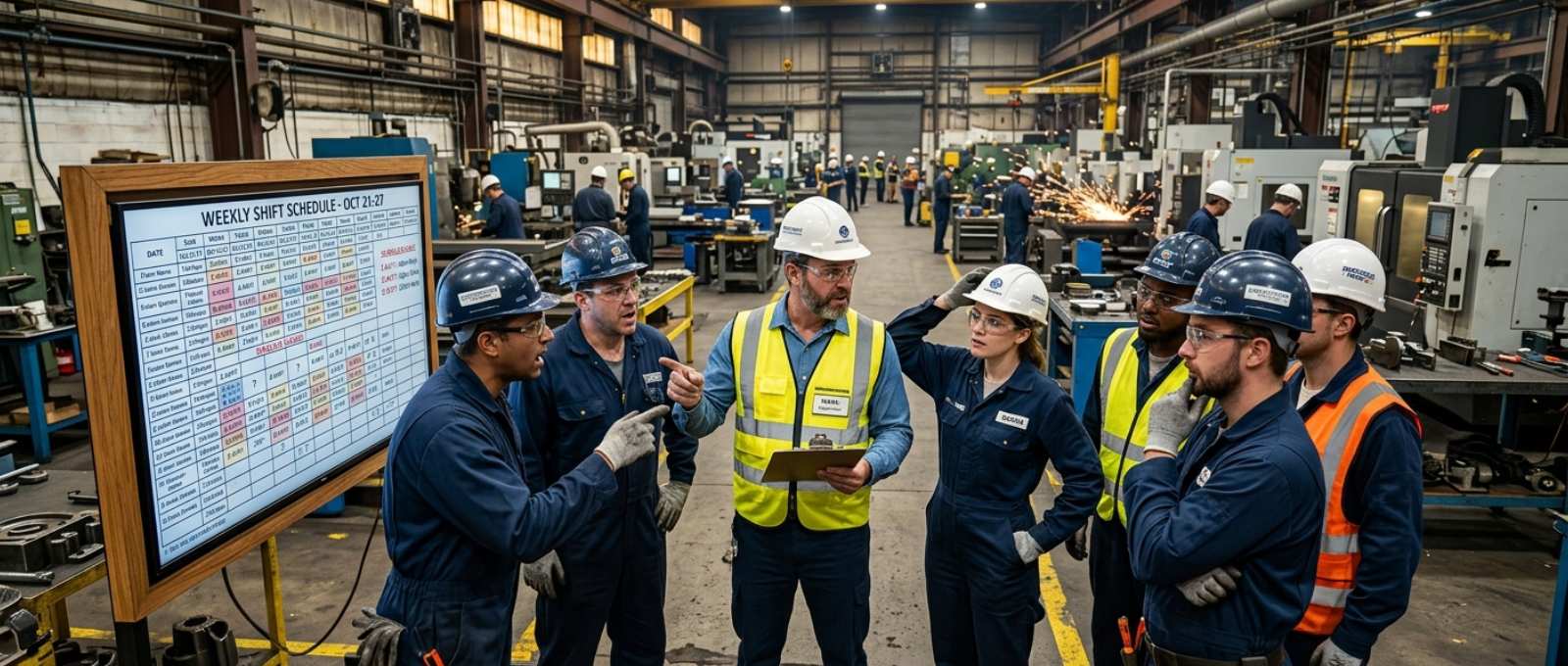
Factories operate in multiple shifts—day, night, rotational, and overtime. Managing these shifts manually becomes chaotic, especially when workers swap shifts or take unplanned leaves.
Without a structured system, managers often face scheduling conflicts, understaffing, or overstaffing, all of which impact production timelines.
Managing rotating schedules becomes even harder as businesses grow. Common issues highlighted in Shift Management in Indian MSMEs show how manual scheduling can lead to conflicts, understaffing, and operational inefficiencies.
Lack of Real-Time Workforce Visibility
Another major Staff Management Challenge in Manufacturing Units is the absence of real-time visibility. Managers often don’t know who is present on the shop floor at any given time.
This lack of transparency leads to poor decision-making, delayed responses, and reduced operational efficiency.
Payroll Errors and Compliance Issues
Payroll in manufacturing is complex. It involves overtime, shift allowances, bonuses, and statutory compliance like PF and ESIC.
Manual calculations increase the risk of errors. Consequently, this leads to disputes, legal risks, and employee dissatisfaction.
Communication Gaps on the Shop Floor
Communication in factories is rarely seamless. Workers may miss updates about shift changes, safety protocols, or operational instructions.
This creates confusion and can even lead to safety hazards, especially in high-risk manufacturing environments.
Employee Productivity and Accountability
Without proper tracking systems, measuring productivity becomes difficult. Managers often rely on assumptions rather than data.
This results in inconsistent performance evaluation and a lack of accountability among workers.
Impact of Poor Staff Management Challenges in Manufacturing Units
When Staff Management Challenges in Manufacturing Units are not addressed, the consequences are significant.
First, productivity drops due to inefficient workforce allocation. Second, payroll inaccuracies increase operational costs. Third, compliance failures can lead to legal penalties.
Moreover, poor workforce management affects employee morale. Workers feel undervalued when attendance or salary errors occur frequently.
Over time, this leads to higher attrition rates, which further increase hiring and training costs.
Proven Solutions to Overcome Staff Management Challenges in Manufacturing Units
Addressing these challenges requires a shift from manual processes to smart, technology-driven systems.
1. QR-Based Attendance Systems
QR-based attendance eliminates buddy punching and manual errors. Workers simply scan a QR code at the workplace to mark attendance.
This method is fast, accurate, and easy to deploy across multiple locations without heavy infrastructure.
2. GPS Tracking and Geofencing
GPS tracking ensures that employees are physically present at the designated location. Geofencing adds an extra layer by restricting attendance marking within a defined area.
This is particularly useful for large manufacturing plants or multiple-site operations.
3. Automated Payroll Systems
Automated payroll software integrates attendance data directly into salary calculations. It handles overtime, deductions, and compliance automatically.
As a result, HR teams save time and reduce errors significantly.
4. Workforce Analytics Dashboards
Analytics dashboards provide real-time insights into attendance, productivity, and workforce trends.
Managers can make data-driven decisions instead of relying on guesswork. This improves efficiency and accountability.
5. Mobile-Based Employee Management
Mobile apps allow workers and managers to stay connected. Employees can check schedules, mark attendance, and receive updates in real time.
This reduces communication gaps and improves overall coordination.
How Technology is Transforming Manufacturing Workforce Management
Technology is rapidly changing how factories handle workforce tracking in manufacturing units.
Cloud-based HR systems now provide centralized control over distributed teams. Real-time data access enables faster decision-making.
Additionally, automation reduces dependency on manual processes, which minimizes errors and improves compliance.
Modern solutions also integrate multiple functions—attendance, payroll, and communication—into a single platform. This creates a seamless management experience.
Tips to Choose the Right Staff Management Software
Choosing the right staff management software can have a significant impact on operational efficiency, workforce productivity, and compliance in manufacturing businesses. However, not every solution is designed to handle the unique challenges of factory environments, such as shift-based operations, multiple locations, and large workforces.
Start by selecting a platform that can scale with your business. As your workforce grows, the software should be able to manage multiple plants, departments, and employee categories without compromising performance. Real-time workforce visibility is equally important, so look for features such as GPS tracking, geofencing, attendance automation, and live reporting.
Compliance should also be a key consideration. The right solution must simplify payroll processing, overtime calculations, and statutory requirements while reducing the risk of manual errors. In addition, an intuitive and user-friendly interface ensures that employees, supervisors, and HR teams can adopt the system quickly with minimal training.
Solutions like QR Staff are specifically designed to address modern manufacturing workforce challenges by combining QR-based attendance, GPS-enabled workforce tracking, shift management, payroll automation, and real-time analytics in a single platform. This helps organizations improve accountability, streamline workforce operations, and make data-driven decisions with confidence.
Finally, choose software that provides actionable insights through detailed dashboards and reports. Access to accurate workforce data enables managers to identify productivity trends, optimize resource allocation, and continuously improve operational performance.
Conclusion
Staff Management Challenges in Manufacturing Units are complex, but they are not unsolvable. With the right approach and tools, factories can transform workforce management into a strategic advantage.
By adopting solutions like QR attendance, GPS tracking, and automated payroll, businesses can improve accuracy, efficiency, and employee satisfaction.
If you’re still relying on manual systems, now is the time to upgrade. The right technology doesn’t just solve problems—it drives growth.
FAQs
What are the biggest staff management challenges in manufacturing units?
The biggest Staff Management Challenges in Manufacturing Units include attendance tracking issues, shift management complexity, payroll errors, and a lack of real-time visibility.
How can factories improve workforce tracking?
Factories can improve workforce tracking in manufacturing units by using GPS-enabled systems, QR-based attendance, and real-time dashboards.
What software is best for manufacturing staff management?
The best software includes features like automated attendance, payroll integration, geofencing, and analytics dashboards tailored for factory environments.
How does automation help in factory workforce management?
Automation reduces manual errors, improves payroll accuracy, ensures compliance, and provides real-time workforce insights.
Why is staff management important in manufacturing units?
Effective staff management ensures productivity, reduces operational costs, and maintains compliance, which is crucial for sustainable growth.
Leave a Reply